
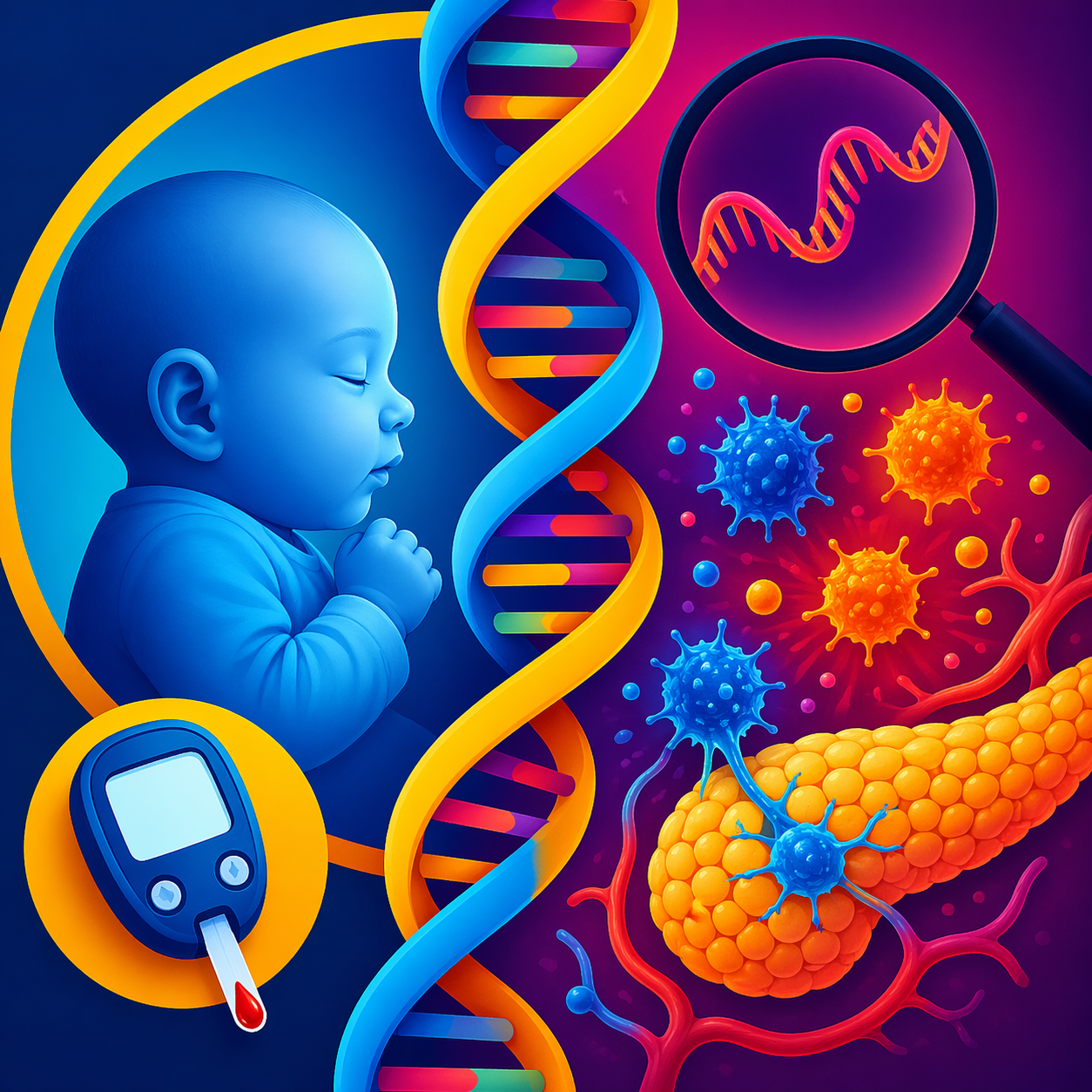
For years, scientists have searched for the genetic roots of disease by focusing on the parts of DNA that act like instruction manuals for making proteins. These regions, known as coding genes, have been the main characters in genetic research. But a new discovery is shifting that narrative and shining a light on parts of our DNA that were once overlooked.
Researchers at the University of Exeter, working with international collaborators and supported by the National Institute for Health and Care Research, have uncovered a new genetic cause of diabetes in infants. Their work points not to protein coding genes, but to a different class of genes that produce functional RNA molecules.
RNA is often thought of as a messenger, but it does much more. It helps control how genes are switched on or off and influences how genetic information is interpreted inside cells. In this study, scientists found that changes in two RNA producing genes, RNU4ATAC and RNU6ATAC, can trigger a rare and serious condition called neonatal diabetes.
This form of diabetes appears within the first six months of life. Unlike more common types, it is caused by genetic changes rather than lifestyle or environmental factors. The researchers identified 19 children with this condition through a global testing program based in Exeter, which offers genetic screening to families worldwide.
What makes this discovery remarkable is not just the genes involved, but how they work. The mutations did not directly damage insulin producing cells. Instead, they disrupted the activity of around 800 other genes, many linked to the immune system. As a result, the body mistakenly attacked its own insulin producing cells, much like what happens in type 1 diabetes.
This gives scientists a rare window into how autoimmune diabetes develops. By studying these children, researchers may uncover new pathways and potential treatments that could benefit people with more common forms of diabetes as well.
Beyond diabetes, the implications are much broader. Rare diseases, taken together, affect about one in 17 people. Yet up to half of those affected never receive a clear diagnosis. Families are often left searching for answers, sometimes for years.
This is where a critical shift in medical practice becomes urgent.
Most genetic testing today still focuses mainly on coding regions of DNA. That means large portions of the genome, including regions like those involved in this study, are often missed. As a result, many patients remain undiagnosed not because the answer is not there, but because we are not looking in the right places.
Whole Genome Sequencing changes that.
Instead of examining only selected regions, it reads the entire DNA sequence, including both coding and non coding areas. In this study, it was the key tool that enabled researchers to uncover the true cause of disease in these children.
The message is clear. If we want to solve more rare diseases, shorten diagnostic journeys, and guide more precise treatments, Whole Genome Sequencing needs to move from being a specialised tool to becoming the first line test in patients with suspected genetic conditions.
For families waiting for answers, this is not just a scientific upgrade. It is a chance for clarity, for earlier care, and for hope grounded in understanding.
The genome has always held the answers. We are finally learning how to read all of it.
Matthew B. Johnson, James Russ-Silsby, Paul A. Blair, Molly Govier, Georgia Bonfield, Clara Domingo-Vila, Matthew N. Wakeling, Richard A. Oram, Sarah E. Flanagan, Timothy I.M. Tree, Kashyap A. Patel, Andrew T. Hattersley and Elisa De Franco, Bi-allelic variants in the non-protein-coding minor spliceosome components RNU6ATAC and RNU4ATAC cause syndromic monogenic autoimmune diabetes 20 March 2026, The American Journal of Human Genetics.
DOI: 10.1016/j.ajhg.2026.02.017