
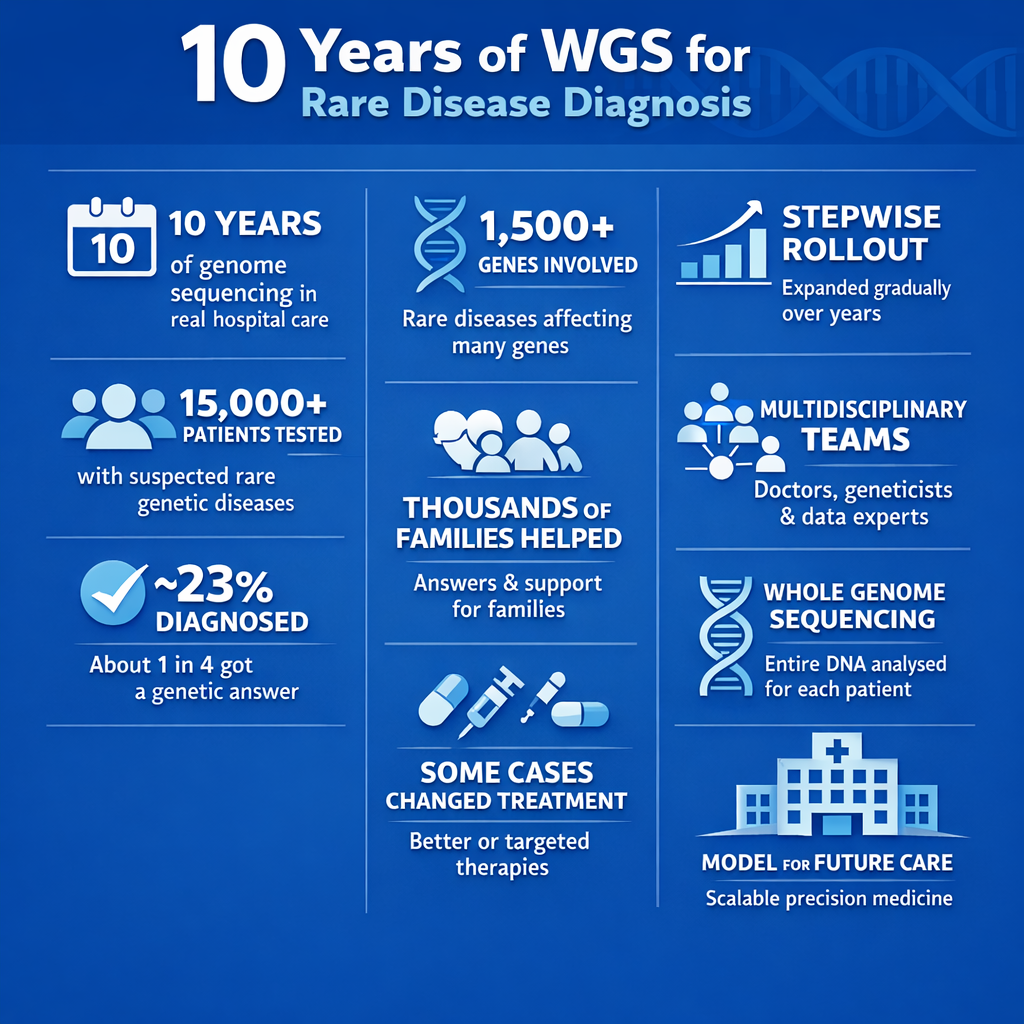
Over the past 10 years, researchers and clinicians in Sweden have been working to solve a frustrating problem: many people with rare diseases never receive a clear diagnosis. This study reports how a large hospital-based genomics program has used whole genome sequencing to change that.
Whole genome sequencing reads a person’s entire DNA, rather than just selected genes. This gives doctors a much more complete view of possible genetic causes of disease. Over a decade, the team analysed more than 15,000 patients suspected of having rare genetic conditions. About 23 percent of them received a clear genetic diagnosis, which is a substantial improvement compared to older testing approaches.
What makes this work particularly important is not just the technology, but how it was implemented. The researchers built a system where clinicians, geneticists, and bioinformatics experts work closely together. Instead of treating sequencing as a separate research activity, they integrated it directly into routine hospital care. This made testing faster, more consistent, and more useful for real patients.
The study also highlights how complex rare diseases are. The diagnoses involved changes in more than 1,500 different genes, showing that no single test or specialist can solve these cases alone. Whole genome sequencing helps uncover these hidden genetic causes, including ones that older methods would likely miss.
Importantly, getting a diagnosis is not just about having a name for a condition. In some cases, it directly changed patient care. For example, certain genetic findings allowed doctors to choose targeted treatments, prevent severe complications, or better predict how a disease might progress.
The researchers also describe a “stepwise” strategy for introducing genome sequencing into healthcare systems. Instead of rolling it out all at once, they gradually expanded its use, improved data analysis pipelines, and built clinical expertise over time. This approach made the system more sustainable and scalable, offering a model that other hospitals and countries could follow.
Overall, the study shows that combining advanced DNA technology with coordinated clinical care can significantly improve diagnosis for people with rare diseases. It marks a shift toward more precise and personalised medicine, where treatment decisions are guided by each person’s genetic information.
Reference
Lindstrand A, Lagerstedt-Robinson K, Jemt A, et al. The genomic medicine center Karolinska 10-year report on genome sequencing for rare diseases and a strategy for stepwise clinical implementation. Genome Med. 2026;18:30. doi:10.1186/s13073-026-01611-3